
Pyramid Scheme

The consulting business model requires a pyramid structure. By building a simple model of this pyramid, we can learn a lot about how these firms operate.
A simple model of the firm
The specific shape of this pyramid is in turn dictated by the type of work the firm performs. Expert-based work requires a lower proportion of analysts to partners, which translates to a more vertical pyramid (i.e., a base that is closer in size to the top).[1] More routine transactional work requires more analysts, resulting in a bigger base relative to the top levels. The model described below is based on a high mix of expert-based work and is roughly in line with how the McKinseys, Bain, and BCGs of the world operate.[2]
In this simplified model, there are four pre-partner levels and one partner level. Each of the pre-partner steps is assumed to take two years, after which the employee will be promoted or fired. I’ve assumed four junior analysts per partner, three senior analysts, and so on--yielding a total ratio of 10.5 non-partners for every partner. Importantly, I have assumed 10% annual growth for the firm.
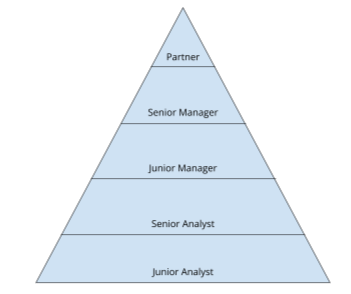
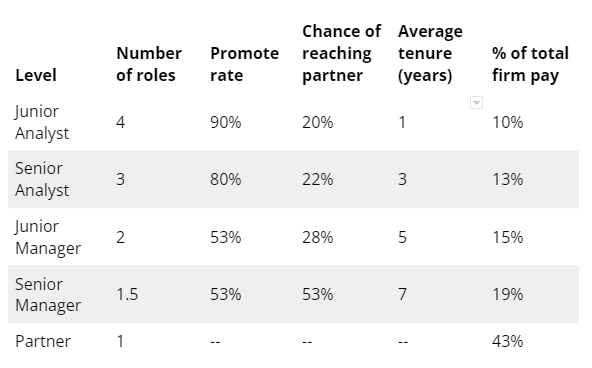
The weighted average promotion rate is 75% across all levels. One has a good chance of achieving the first promotion or two, but by the final pre-partner rank, one only has a 50% chance of being promoted to partner (after all those years of toil!). The multiplicative nature of these promotion windows means that most people who start will not become partners: only one of out five new analysts will make it.[3]
Looking at wages indicates the extent to which these firms are run for the benefit of their owners (i.e., the partners). Partners’ pay makes up around 40% of total pay despite their making up less than 10% of consulting personnel.
The high turnover means that the average tenure at the firm (excluding partners) is just over three years.
The up-or-out structure inevitability results in high attrition rates relative to most other business models. Exactly how high this attrition goes is dependent on the rate of growth enjoyed by the firm (holding all other factors, such as the type of work the firm performs, constant). As the sensitivity table below shows, annual attrition is 50% higher in a no-growth environment compared to one with 9% growth.
Implications of the model
I will now consider the second-order effects of this model, roughly following the career lifecycle of a consultant.
Recruiting
Recruiting is a strategic function for a consulting firm. With high turnover and a product that relies almost entirely on its people (or at least the client’s perception of them), sourcing the right people is critical. One bad year or two can throw off the entire pyramid structure for years to come--sort of a reverse baby boom. However, that does not mean the firms need to be skilled at identifying future partners. They only need to identify and attract people who have the attributes to succeed at the level at which they are hiring. Presumably a high enough proportion of those people will turn out to have the skills required for the next level; those who don’t will be asked to leave.
At the firm I know best, it is common for nearly all consulting staff to invest hours each week during recruiting season wooing candidates (many of whom will not even receive offers). The firm has no choice but to invest significant resources when it comes to finding the next generation to fill the base of the pyramid.
Career
“Apprenticeship” is a frequent term within consulting firms. It is true that to a greater degree than most other jobs, a consultant learns by watching and imitating those around him. The flip side of the apprenticeship model is that one is being trained for one’s current role or one level up at most. Apprentice electricians do not study how to be a manager of their company, and junior analysts are not mentored in how to, say, manage a team. The firm is most interested in one’s performance today. This is not necessarily wrong, but it is not the impression usually given during recruiting.
Retention
The up-or-out model necessarily involves competition and attrition. Ceteris paribus, higher attrition has to be counterbalanced by either higher pay, higher future pay, or both. Increasing forced attrition--perhaps due to slowing growth--without a subsequent increase in either of these pays is likely to lead to higher voluntary attrition as people lose motivation. To use an analogy, increasing the number of bullets in the revolver when playing Russian roulette will necessitate a much larger reward for playing (and surviving). At some point, the chance of failure becomes so high that no one is willing to play.
Consulting in an AI world
If the work performed by the lower levels of the pyramid is able to be done by computers, then the entire consulting business model will need to be overhauled. No longer will firms be able to hire just for the analyst roles and then select from internal ranks for each subsequent level of the pyramid. Instead, they will need to directly hire the project managers (to deliver the work) and partners (to sell the work), presumably for much longer tenures than today. Benedict Evans compares AI to having an army of interns; if those interns ever reach the level of MBB analysts, the firms will have to completely overhaul how they operate internally.
Summary
The pyramid structure of consulting firms results in a tournament setup. A lucky or skillful few will reap large rewards for surviving the gauntlet to partner. At least for now, the implicit bargain with recruits--we will give you a sizable bump in pay compared to other firms along with the possibility of a large pot of gold in eight years--for now is working. However, this balance could be overthrown if growth slows or AI obviates the need for armies of analysts in the first place.
For more on this, see Managing the Professional Service Firm by David Maister.
This does not take into account some of the newer businesses these firms operate, such as McKinsey Implementation, which are more transactional, or McKinsey Solutions, which are arguably of a different kind entirely.
This model does not account for hiring at the MBA level. So compared to the numbers shown, the attrition for junior analysts is higher in reality due to the influx of MBA hires.